
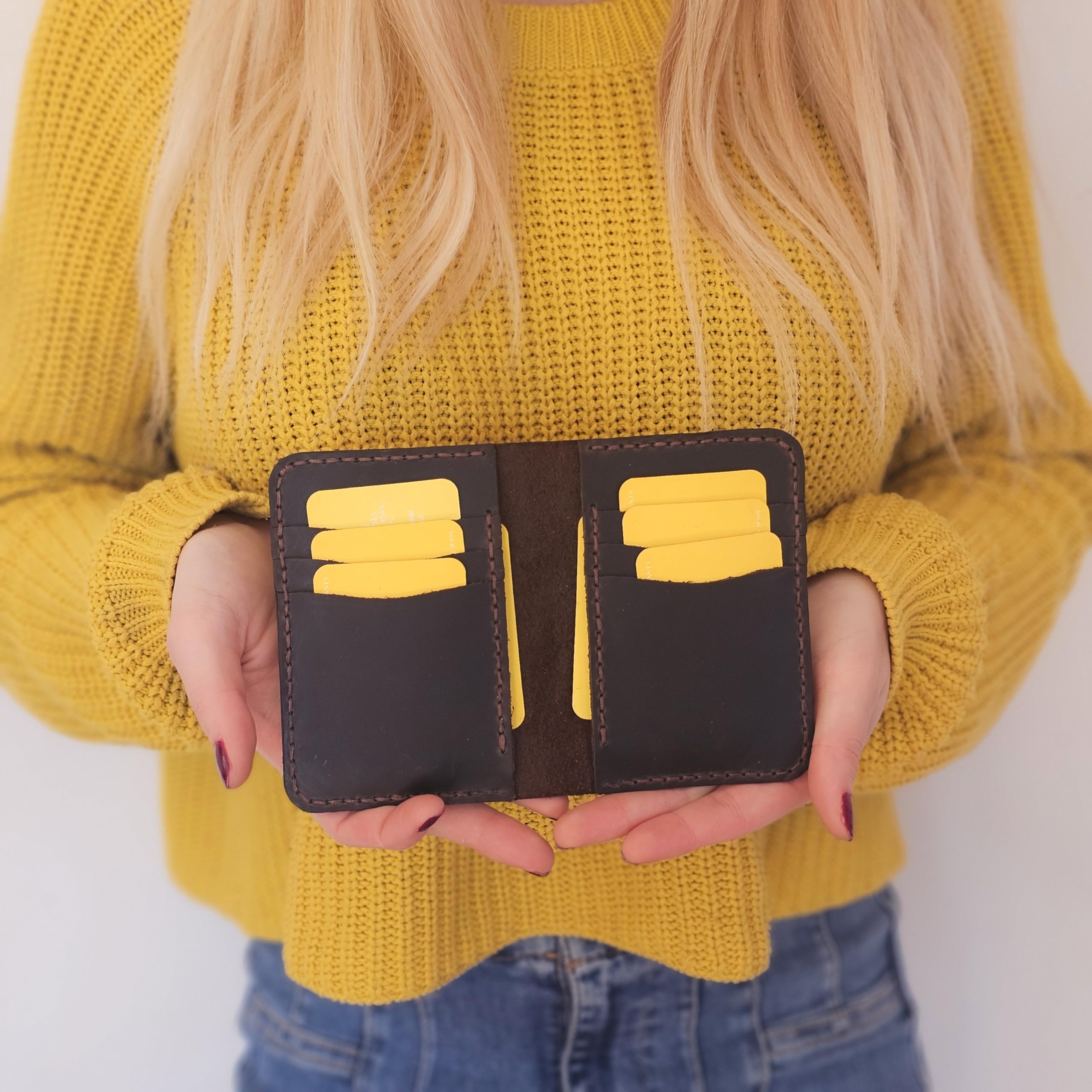
A card holder carries cards and very little else. A wallet carries cards and cash, and usually a few things you forgot were in there. The choice is less about style than about three questions: how much cash you still use, which pocket you carry in, and how many cards you really need with you every day.
The quick difference
| Leather card holder | Bifold wallet | |
|---|---|---|
| Typical capacity | 4–8 cards, a folded note or two | 6–14 cards plus flat notes |
| Thickness loaded | Roughly 6–10 mm | Roughly 12–18 mm |
| Best pocket | Front trouser, shirt, jacket | Back trouser, bag, jacket |
| Cash | Folded, awkward | Flat, easy |
| Where it wears first | Slot mouths | The spine |
Choose a card holder if…
- You tap for almost everything. If your phone or a card covers nearly every payment, most of a wallet’s volume is empty.
- You carry in a front pocket. A card holder is small enough to sit in a front trouser pocket without a visible outline, and it does not press into your leg when you sit.
- You want it to disappear in a jacket. A slim leather card holder in an inside pocket leaves no rectangle across the chest.
- You are trying to carry less. A card holder forces the edit. Receipts and old loyalty cards have nowhere to hide.
Choose a wallet if…
- You still use cash regularly. Notes have to fold twice to fit most card holders. Do that daily and it gets old fast.
- You need an ID on show. Most card holders have no window. An ID wallet keeps a licence readable without taking it out.
- You carry more than eight cards. Card holders overfilled beyond their design stretch at the slots and never recover.
- You keep a back-pocket habit. A horizontal bifold is the shape a back pocket suits best.
The middle ground
There is a category in between: the slim bifold or card wallet. It folds like a wallet but is built around fewer card slots and a single note compartment, so it holds flat cash without the thickness of a full bifold. If you are torn, this is usually the answer — see our minimalist wallets.
Another is carrying both: a card holder for daily errands, a wallet for travel days when you need cash, receipts and a second currency.
Card holders for men and for women
The functional design is the same; what changes is how they are carried. Men’s card holders are usually sized and shaped for a trouser or jacket pocket, in darker leathers. Women’s are more often carried in a bag, where a brighter colour is easier to find and a snap or zip closure keeps cards in place when the bag is jostled. A plain slim leather card holder works for either.
What makes a card holder last
- Stitched slot edges. Card holders wear at the slot mouths, where cards are pulled in and out. Hand-stitched edges hold that stress; glued ones open.
- Skived layers. Where panels overlap, the leather should be thinned. Otherwise a four-slot holder stacks into eight full layers and will not lie flat.
- Full-grain leather. It stretches to your cards over the first few weeks and then holds that shape. Coated or bonded leather cracks at the slot folds. The leather grades explained.
- Do not overload it early. New slots are tight by design. Give the leather a week or two with the cards you actually carry and it moulds to them.
Short answer
- Mostly cards, front pocket → leather card holder
- Cash and cards, back pocket → bifold wallet
- In between → slim minimalist wallet
- Need your ID visible → ID wallet