
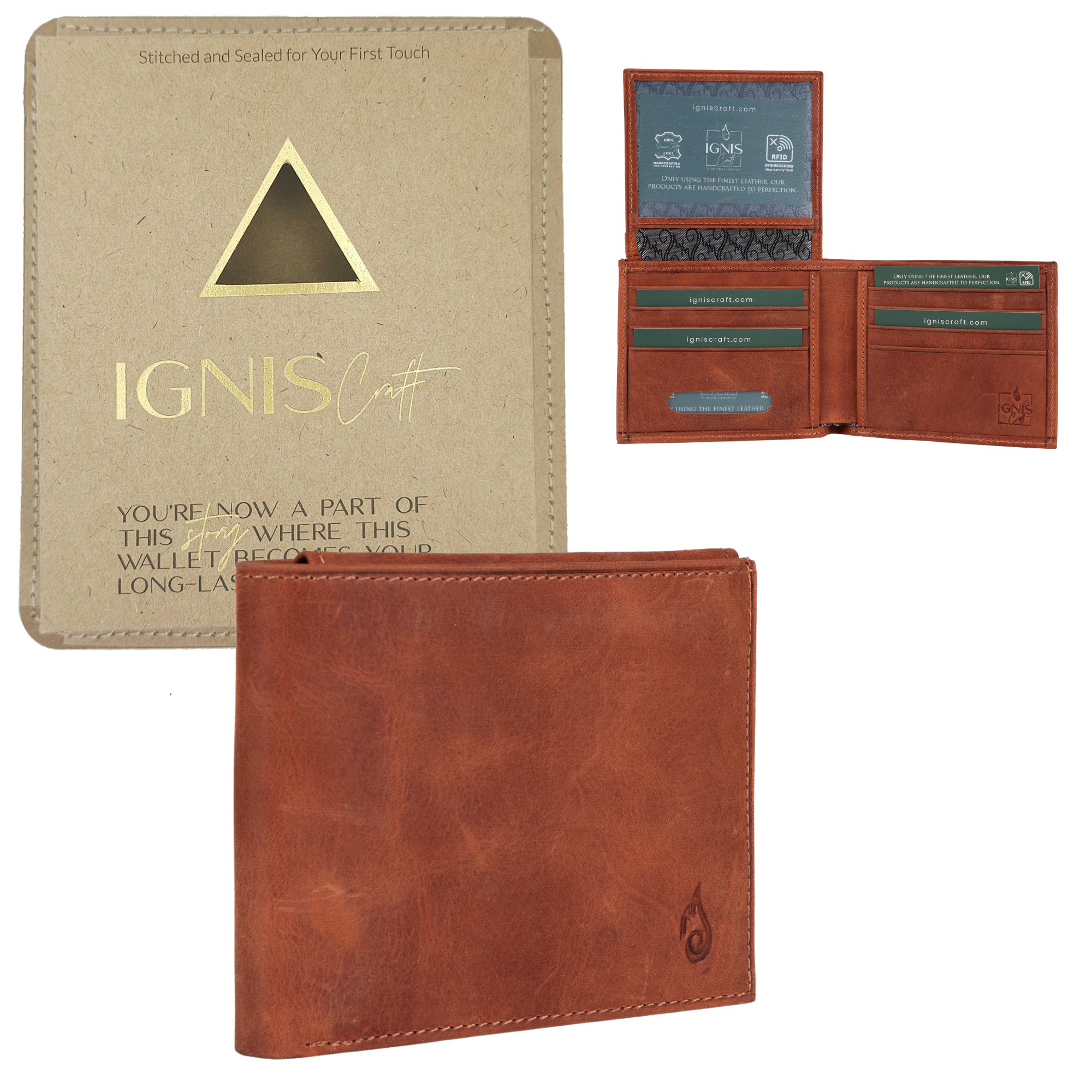
An ID wallet is a wallet with a clear window sized for a driver’s licence or ID card, so the card can be read without taking it out. That is the whole definition. What varies — the fold, where the window sits, how many cards it carries around the ID — decides whether one is useful to you or just a gimmick you stop using after a month.
What an ID window is, and what it is made of
The window is a pocket with a transparent face, usually a flexible clear film stitched into the leather. It is cut for the standard card size — 85.6 by 54 mm, the same size as a bank card — which is what US driver’s licences, most national ID cards and many staff badges use.
The film is the part that ages first. It scratches, it can cloud over time, and cheaper films go yellow and stiff. A well-made window sits slightly recessed inside a leather frame so the film is not the first thing that touches a table or a pocket seam.
Who actually benefits from one
- People who show ID often. Bars, office security, building access, pharmacy pick-ups. Sliding a card in and out of a tight slot ten times a week curls the corners and wears the print. Behind a window it barely moves.
- People who carry a badge or transit card. A window works for anything that is read by sight or held against a reader. A contactless transit card can often be tapped through the film, though an RFID-blocking lining behind it will stop that.
- Anyone who loses cards. A card behind a window is visibly there. An empty window is noticed before you leave the counter.
If you rarely show ID, a window is dead space — a card slot that holds one card instead of two. You are better served by a plain bifold or a slim card holder.
Where the window sits: the four common layouts
Inside the bifold
The most common layout. Open the wallet and the ID faces you on one side. Discreet, protected when closed, and it is how most leather ID wallets are built.
On the outside
The window is on the back panel, readable without opening the wallet. Fastest to show, but the film is exposed to every surface the wallet touches and wears out much sooner.
On a flip-out panel
A hinged inner leaf holds the window, often with extra card slots. Good capacity, but it adds a layer at the spine, so these wallets are thicker.
Card holder with a window
A single flat piece with one window and a few slots. The minimal version, for people who carry an ID, two cards and no notes.
What to check before choosing one
- Window size. It should hold the card firmly without bowing the film. A loose window lets the card slide down and out of view.
- Stitching around the window. The frame takes stress every time a card goes in. Stitched edges hold; glued frames lift at the corners.
- How many slots sit behind the ID. Cards stacked behind the window push against the film and make it bulge. Two cards behind is fine; four is not.
- RFID lining, if you want it. It protects the bank cards but also blocks tapping a transit card through the window. Decide which matters more. What RFID blocking actually does.
Men’s and women’s ID wallets
The difference is almost entirely format rather than function. Men’s ID wallets are usually bifolds sized for a trouser pocket. Women’s are more often long wallets, wristlets or card cases with a window, built to live in a bag. The window itself is the same card size in both.
Caring for the window
Wipe the film with a dry or barely damp cloth. Keep leather conditioner off it — oils cloud the film and can soften the stitching around it. If the window scratches, the wallet still works; a clouded window is a cosmetic issue, not a failure.
Short answer
- An ID wallet is a wallet with a clear window for your licence or ID card.
- Worth it if you show ID several times a week; dead space if you do not.
- Best all-round layout: window inside a bifold.
- Browse leather wallets with an ID window.
- Carry only cards? A leather card holder is slimmer.
- Not sure about fold direction? Vertical vs horizontal bifold.